eBioMedicine (volume 132, October 2026) has published the second set of results from a cluster-randomised trial led by the Environmental Health Institute of Singapore’s National Environment Agency (NEA): residential clusters where male Aedes aegypti carrying Wolbachia were released had clearly lower dengue incidence than control clusters.
Main points
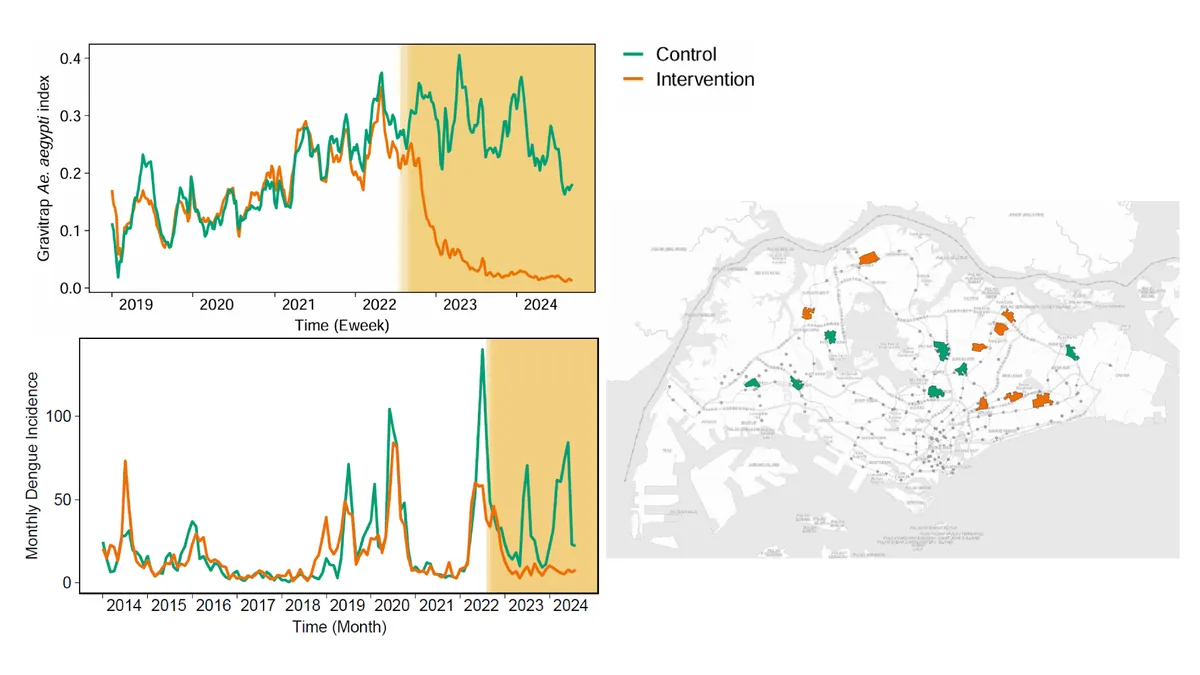
- The trial had 15 clusters: 8 received releases of male mosquitoes carrying the wAlbB Wolbachia strain (393,236 residents) and 7 were controls (331,192 residents); all kept their routine vector control. The mosquitoes were given a low dose of radiation to sterilise any residual females. Releases started in epidemiological week 30 of 2022 and the trial ended in week 37 of 2024.
- Before the intervention, incidence per 100,000 residents was almost the same (18.63 in the control arm, 18.14 in the intervention arm). During the intervention, reported incidence was 11.31 in the intervention arm against 36.57 in the control arm.
- Six months after releases began, reductions in total dengue incidence in intervention clusters ranged from 27.6% to 83.8%; reductions in epidemiologically linked cases (local transmission) were larger, from 60.9% to 99.8%. The effect weakened at times during the 2023 inter-epidemic period.
- The authors estimate that 2,351 cases (95% CI 1,968–2,735) were averted during the trial, against 1,037 cases reported in the intervention arm. The open-access paper is published under a CC BY licence and was funded by Singapore’s Ministry of Finance.
VPMA’s note
The Association website has already reported the first set of results from the same trial (a 71–72% reduction in risk). This new paper measures case numbers directly at cluster level, adding evidence for suppressing mosquito populations with Wolbachia males. It is a complementary measure that still goes together with larval control and outbreak response under health sector guidance.
- Source
- eBioMedicine – Impact of Wolbachia-mediated incompatible and sterile insect techniques on dengue incidence: a large-scale cluster randomised controlled trial
- Published
- October 2026
- Section
- New approaches to insect control
- Journal
- eBioMedicine 2026;132:106476
- DOI
- 10.1016/j.ebiom.2026.106476
- Trial registration
- NCT05505682
Source: eBioMedicine – Impact of Wolbachia-mediated incompatible and sterile insect techniques on dengue incidence: a large-scale cluster randomised controlled trial (summarised in English by VPMA). Read the Vietnamese page.