A paper of 27 May 2026 tested Ae. aegypti from Brazil, Paraguay and Peru with wMelM or wAlbB against DENV-1 or DENV-2. wMelM blocked virus more strongly than wAlbB in every population; blocking was strongest in the Brazil line and weakest in Peru. wAlbB gave higher modelled population fitness in the laboratory.
Main points
- Journal: PLoS Negl Trop Dis 20(5): e0014403. DOI 10.1371/journal.pntd.0014403. Received 27 January 2026; accepted 22 May 2026; published 27 May 2026. Funded by NIAID R56 AI155573-01A1.
- Each country line was backcrossed for six generations to females carrying wMelM or wAlbB; Wolbachia-free controls were kept. Infection prevalence and viral load were measured in salivary glands and carcass at days 5, 10 and 15 after infection.
- The three-way interaction was statistically significant. wMelM reduced DENV prevalence and load in salivary glands more than wAlbB. Blocking was stronger against DENV-2 than DENV-1. The Brazil line often showed the strongest blocking; the Peru line was weaker.
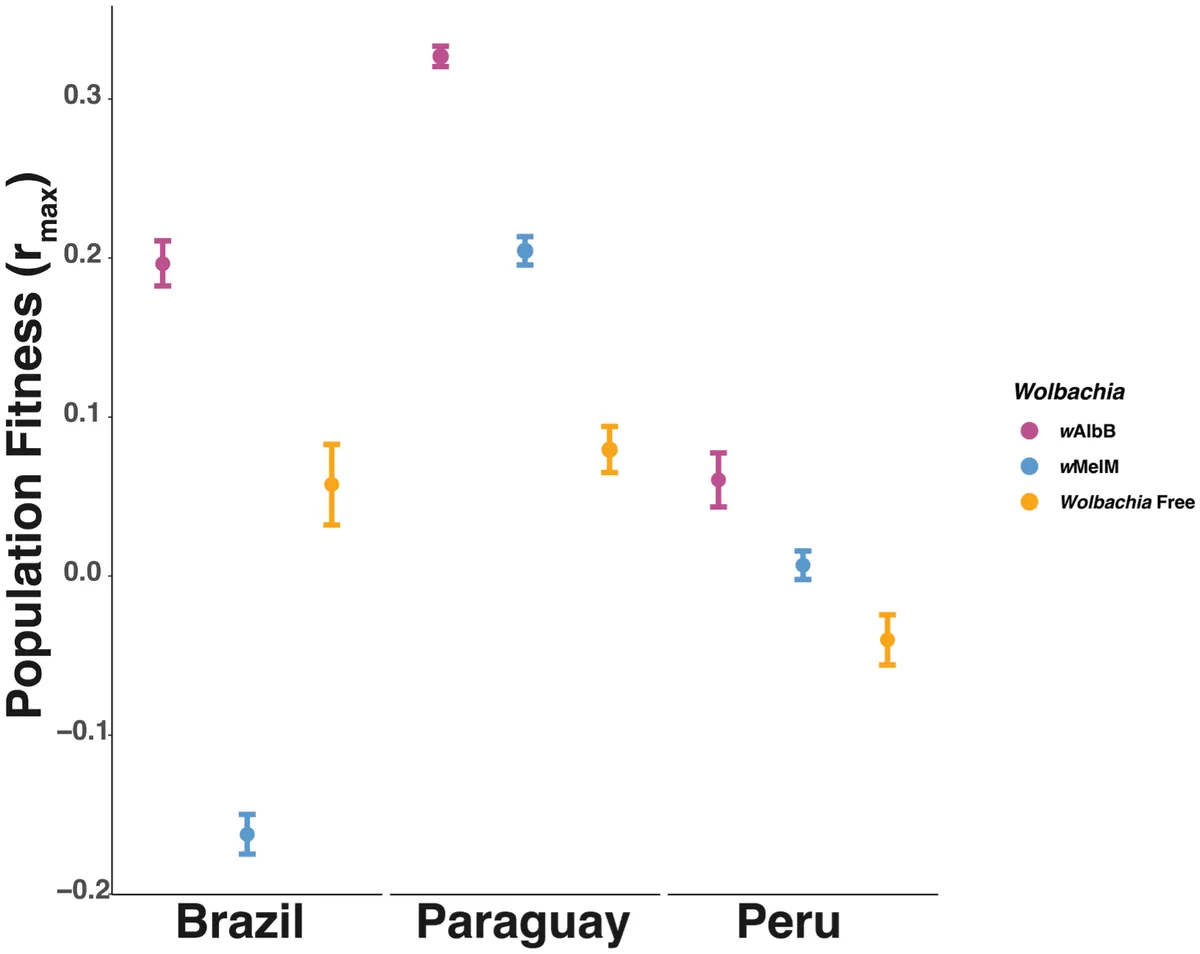
- On fitness: fecundity mainly tracked gonotrophic cycle; survival fell in most Wolbachia groups, most sharply in Brazil; development rate depended on the strain–population interaction. In the r_max model, wAlbB groups were about 1.5–2.3 times higher than wMelM depending on country. Laboratory work, not a field-release result.
VPMA’s note
The paper shows there is no single “best” Wolbachia strain for every population. Do not extrapolate the Brazil–Paraguay–Peru figures to Vietnam.
- Source
- PLOS Neglected Tropical Diseases
- Published
- 27 May 2026
- Section
- Research · Insects
- Journal
- PLoS Negl Trop Dis 20(5): e0014403
- DOI
- 10.1371/journal.pntd.0014403
Editorial note: This is a short summary and comment by VPMA, not a full copy. The original text and copyright belong to the source cited. The illustration is symbolic and is not a photograph of the event.
Source: PLOS Neglected Tropical Diseases (summarised in English by VPMA). Read the Vietnamese page.