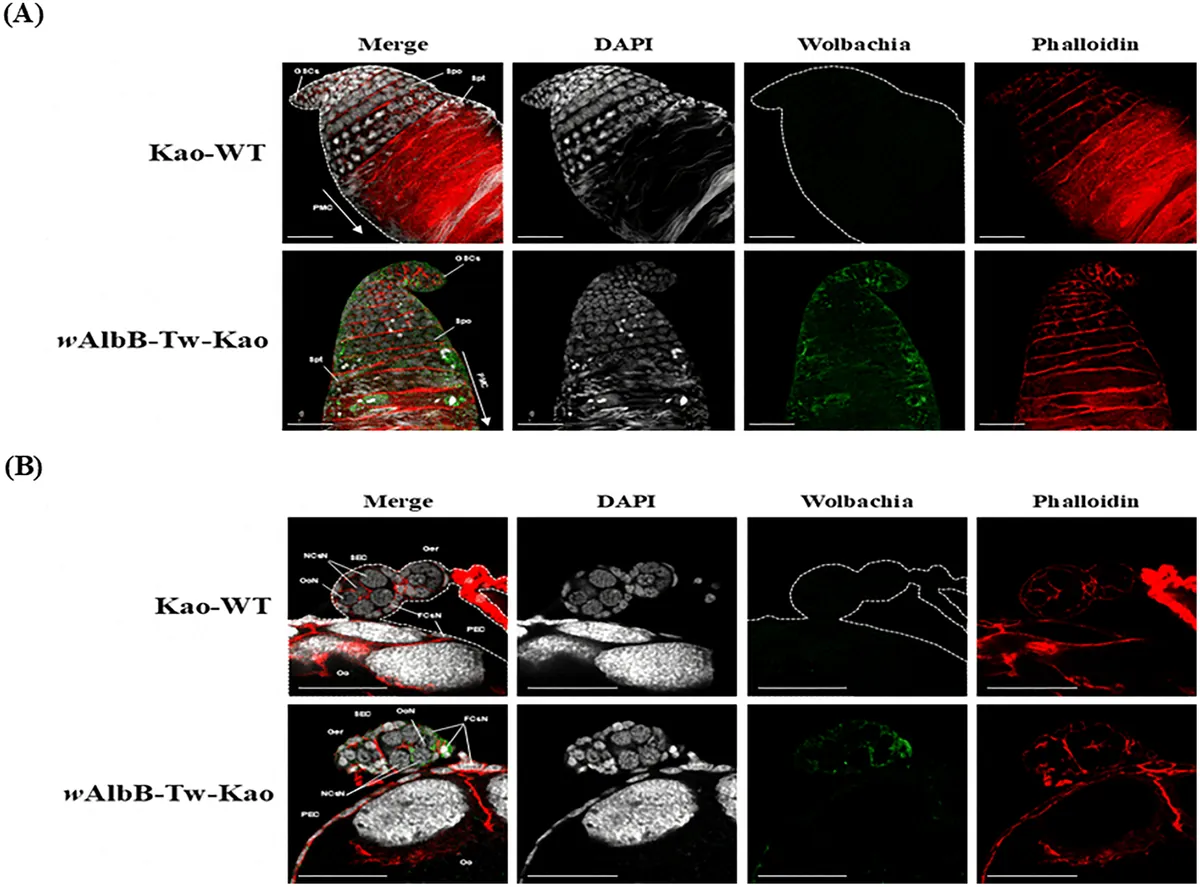
A paper of 4 May 2026 in PLOS Neglected Tropical Diseases describes a local Ae. aegypti line carrying Wolbachia wAlbB (wAlbB-Tw-Kao) from Kaohsiung Ae. albopictus. The line showed 100% maternal transmission, complete cytoplasmic incompatibility, lower DENV-2 and Zika titres, and up to about 90% lower egg hatch in cage releases of males.
Main points
- Journal: PLoS Negl Trop Dis 20(5): e0014222. DOI 10.1371/journal.pntd.0014222. Received 18 November 2025; accepted 7 April 2026; published 4 May 2026. Funded by Taiwan’s National Health Research Institutes (NHRI), grant 14A1-MRPP04-014.
- Cytoplasm containing wAlbB from Kaohsiung Ae. albopictus was injected into local Ae. aegypti embryos; after at least nine backcross generations, maternal transmission was stable at 100%. Tw-Kao males crossed with uninfected females: 0% egg hatch (complete CI).
- Oral challenges with DENV-2 and Zika: lower infection rates and titres in midgut, salivary glands and saliva than in the wild-type line. In competitive cages, raising the ratio of WT females : WT males : Tw-Kao males reduced hatch; the highest reduction was about 90% versus the compatible control.
- The Fried competitiveness index for males was about 0.58–0.76 at higher release ratios. Pyrethroid susceptibility of Tw-Kao did not differ significantly from the local line. The paper is a laboratory and cage evaluation, not a field release in Vietnam.
VPMA’s note
These are laboratory results from Taiwan. Do not use the Tw-Kao figures to describe a release programme in Vietnam.
- Source
- PLOS Neglected Tropical Diseases
- Published
- 4 May 2026
- Section
- Research · Insects
- Journal
- PLoS Negl Trop Dis 20(5): e0014222
- DOI
- 10.1371/journal.pntd.0014222
Editorial note: This is a short summary and comment by VPMA, not a full copy. The original text and copyright belong to the source cited. The illustration is symbolic and is not a photograph of the event.
Source: PLOS Neglected Tropical Diseases (summarised in English by VPMA). Read the Vietnamese page.