
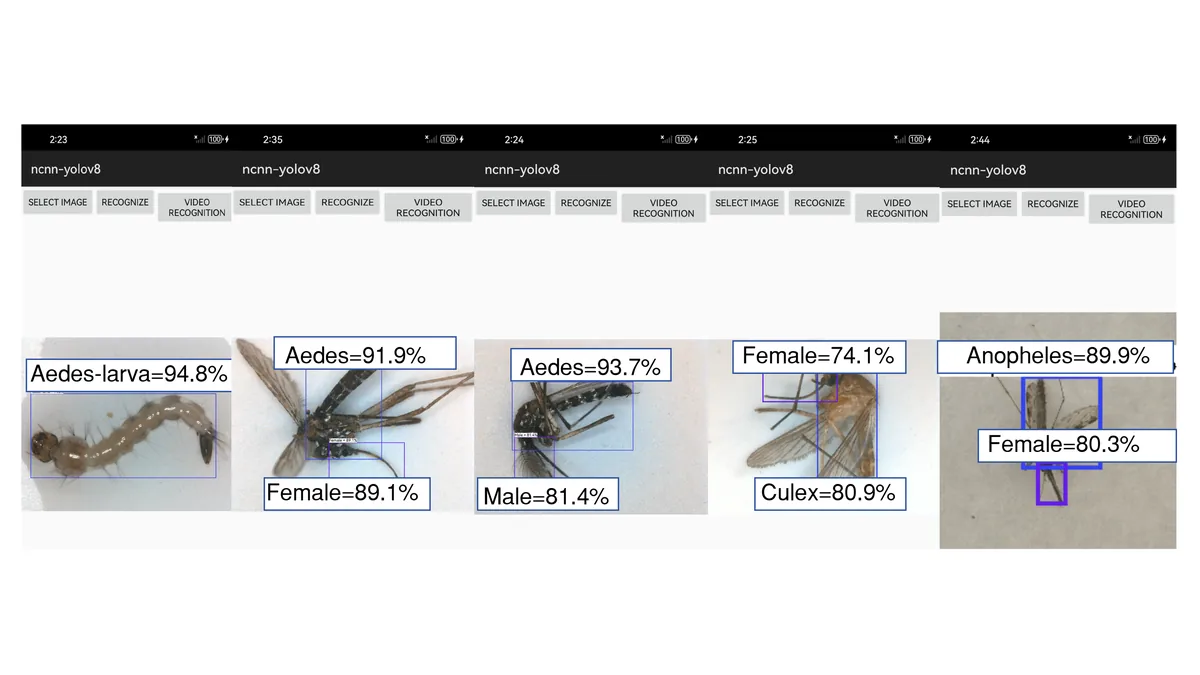
A study published in PLOS One on 9 October 2026 by China Jiliang University and the Hangzhou Center for Disease Control and Prevention built a deep learning system that recognises mosquitoes from both adult and larval morphology and runs directly on Android phones.
Main points
- The dataset has 2,683 images of the three main disease-carrying genera (Aedes, Culex, Anopheles), covering adult males and females and Aedes and Culex larvae; samples came from the field, from laboratory-reared strains and from the public Kaggle mosquito dataset, split 8:1:1 for training, validation and testing.
- Five algorithms were compared: YOLOv8, YOLOv5, SSD, Faster R-CNN (ResNet50) and Faster R-CNN (MobileNetv2). YOLOv8 performed best, with precision 0.988, recall 0.990, mAP50 0.992 and F1 0.99, using only 2.7 million parameters. In the confusion matrix: Aedes 0.99; Culex 0.98; Anopheles 1.00; male 0.97; female 0.97; Aedes and Culex larvae 1.00.
- The model was converted to the NCNN framework to run on Android; the app supports recognition of images from the gallery and real-time video, showing a box, the class name and the probability.
- Limitations reported by the authors: false detections remain in complex scenes (55% of background regions were misclassified as Culex larvae and 30% as female mosquitoes), which may overestimate mosquito numbers; field performance also depends on lighting, background, camera resolution and motion blur.
VPMA’s note
Fast mosquito identification on a phone could help field staff during entomological surveys, especially to tell Aedes larvae from Culex larvae. It is still a research result, not widely tested in the field, and identifications still need confirmation by trained staff.
- Source
- PLOS One – CNN-based dual-morphology mosquito recognition and mobile deployment
- Published
- 9 October 2026
- Section
- New approaches to insect control
- Journal
- PLOS One (2026), open access
- DOI
- 10.1371/journal.pone.0359976
Editorial note: This is a short summary and comment by VPMA, not a full copy. The original text and copyright belong to the source cited. Picture: Figure 10 of the PLOS One paper (recognition results in the phone app; CC BY licence).
Source: PLOS One – CNN-based dual-morphology mosquito recognition and mobile deployment (summarised in English by VPMA). Read the Vietnamese page.