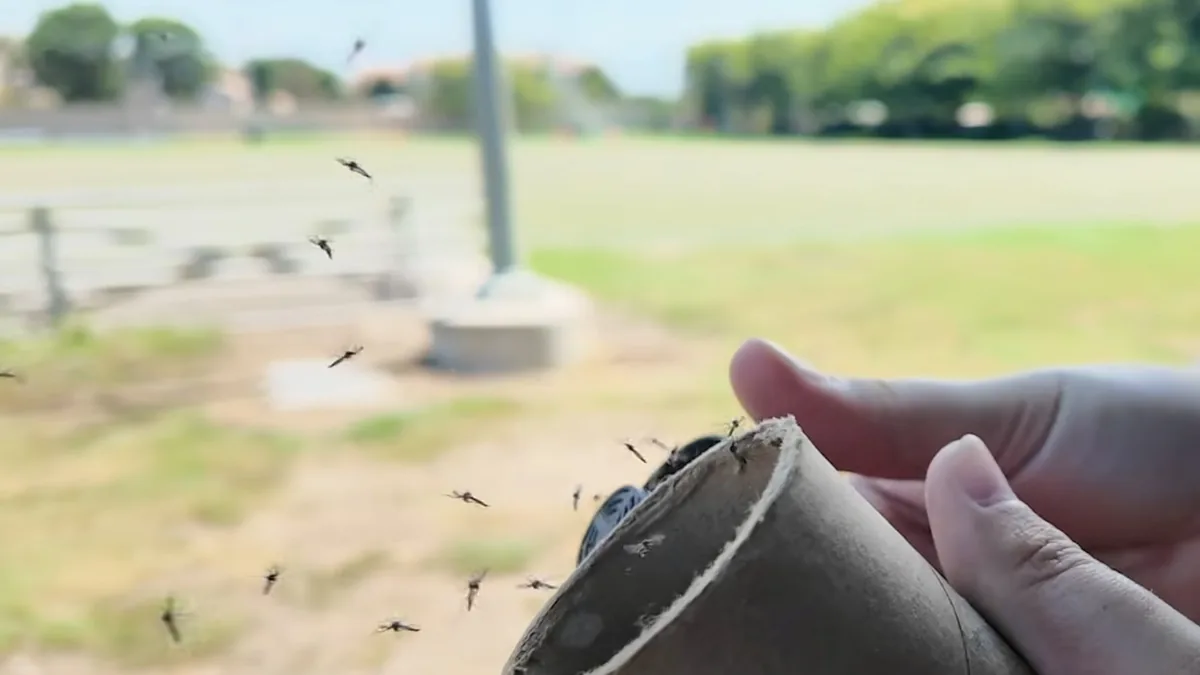
The Guardian reported on 17 September 2026 (a Climate Central story) that the San Gabriel Valley Mosquito and Vector Control District, east of Los Angeles, is releasing about 30,000 male Aedes aegypti carrying Wolbachia bacteria each week, nearly half a million in all. Males do not bite; eggs from wild females that mate with them do not hatch.
Main points
- Each paper tube holds 600 males, shipped overnight from MosquitoMate in Lexington, Kentucky. Tristan Hallum oversees the district’s scientific programmes.
- According to Stephen Dobson (MosquitoMate), the technique involves no genetic modification: a naturally occurring bacterium is moved from one mosquito to another. The EPA has approved mosquito-control products using Wolbachia-infected males.
- Success is judged by counting female Aedes aegypti in traps, not the number released. The article cites earlier studies reporting 80–95% reductions in some release areas, depending on local conditions.
- Context: California recorded its first locally acquired dengue cases in 2023 (Pasadena, Long Beach); the CDC identified 14 locally acquired cases in Los Angeles County between August and November 2024. Climate Central found nearly 95% of US cities analysed now have more days suitable for mosquitoes than in the early 1970s, 18 days a year on average.
VPMA’s note
A US programme. This is population suppression with incompatible males, different from the population-replacement releases of the World Mosquito Program; it does not mean Vietnam is using it.
- Source
- The Guardian (Climate Central)
- Published
- 17 September 2026
- Section
- New approaches to insect control
- Mosquito supplier
- MosquitoMate, Kentucky
Editorial note: This is a short summary and comment by VPMA, not a full copy. The original text and copyright belong to the source cited. Picture: Climate Central, in The Guardian article of 17 September 2026.
Source: The Guardian (Climate Central) (summarised in English by VPMA). Read the Vietnamese page.