
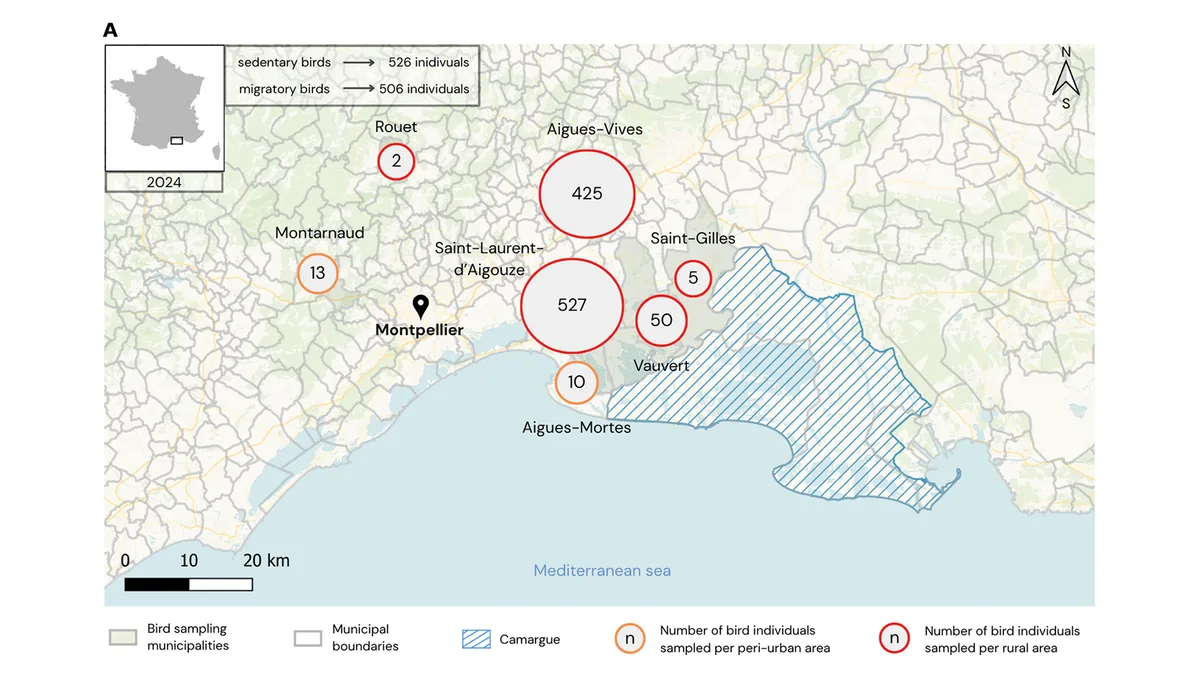
A paper of 3 September 2026 in PLOS Neglected Tropical Diseases: a Montpellier team sampled 2,533 wild birds of 69 species in the Camargue–Montpellier area over 2024–2025. Usutu virus RNA was found in 12.0% of birds and West Nile virus RNA in 4.3%; circulation was markedly higher in 2024 than in 2025.
Main points
- Journal: PLoS Negl Trop Dis 20(9): e0014397. DOI 10.1371/journal.pntd.0014397. Received 19 May 2026; accepted 23 August 2026; published 3 September 2026. Authors: Beaubaton R, Revel J et al. (University of Montpellier).
- Both viruses follow a Culex pipiens mosquito–bird cycle, with birds as amplifying hosts; humans and horses are dead-end hosts. Samples were cloacal swabs and droppings tested by RT-qPCR.
- High rates in resident birds such as house sparrows (Usutu 21.5%, West Nile 13.4%) and great tits (Usutu 17.6%, West Nile 5.1%); among migrants, barn swallows had Usutu 12.4% and West Nile 2.4%. Co-infection was 2.0%: 4.1% in 2024 and 0.6% in 2025.
- The viruses appeared in birds early in the season, before cases in humans and horses and before detection in mosquitoes. In 2024 the study area reported 12 human West Nile infections.
VPMA’s note
A study in France, not Vietnamese data. The takeaway: watching host birds can give early warning before human cases, alongside Culex mosquito surveillance.
- Source
- PLOS Neglected Tropical Diseases
- Published
- 3 September 2026
- Section
- Research · Vector-borne disease
- Journal
- PLoS Negl Trop Dis 20(9): e0014397
- DOI
- 10.1371/journal.pntd.0014397
Editorial note: This is a short summary and comment by VPMA, not a full copy. The original text and copyright belong to the source cited. Picture: Figure 1 of the PLOS NTDs paper (map of bird sampling sites in 2024–2025, CC BY licence).
Source: PLOS Neglected Tropical Diseases (summarised in English by VPMA). Read the Vietnamese page.