
A paper of 30 July 2026 in PLOS ONE: a randomised trial in Tambai, central Mozambique, sprayed IR3535 as a spatial repellent in 40 households and compared them with 40 control households. Indoors, 765 female An. funestus were caught in the repellent group and 1,432 in the control group; 18.6 versus 35.0 per household on average. Malaria prevalence in children under five fell similarly in both groups.
Main points
- Journal: PLoS One 21(7): e0353351. DOI 10.1371/journal.pone.0353351. Received 8 October 2025; accepted 9 June 2026; published 30 July 2026. Authors: Lequechane JD et al. Trial registration NCT04419766; intervention period July 2021 – July 2023.
- 5,716 mosquitoes were collected: 57.2% Anopheles and 42.7% Culex. An. funestus s.l. dominated indoors (92.7%) and outdoors (82.5%). Outdoors, the repellent group had 175 versus 293; 4.3 versus 7.1 per household.
- P. falciparum prevalence in children under five fell from 72.6% at baseline to 51.3% after one year and 43.3% at the end, with similar falls in the repellent and control groups. Sporozoite rates were slightly lower in the repellent group, especially outdoors, but could not be attributed to the repellent.
- The authors conclude that IR3535 used as a spatial repellent reduces indoor and outdoor malaria vector densities, which may contribute to lower transmission.
VPMA’s note
A small trial against malaria mosquitoes in Mozambique; lower transmission is not proven. It does not mean any matching product or use is authorised in Vietnam.
- Source
- PLOS ONE
- Published
- 30 July 2026
- Section
- New approaches to insect control
- Journal
- PLoS One 21(7): e0353351
- DOI
- 10.1371/journal.pone.0353351
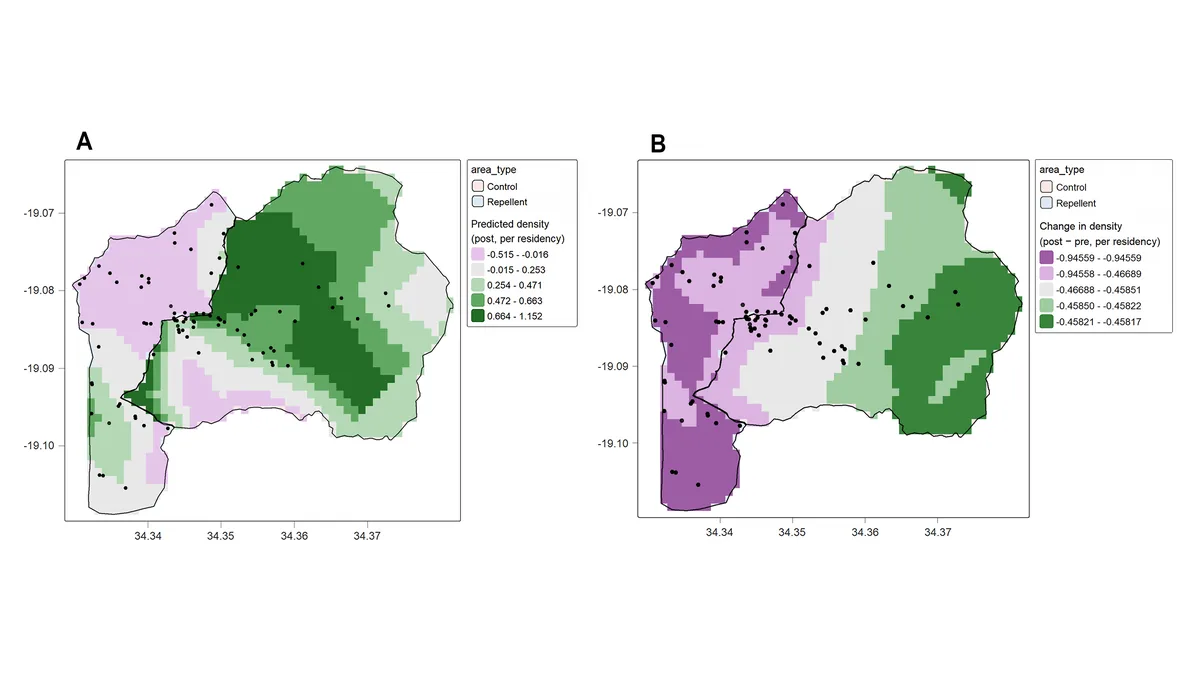
Editorial note: This is a short summary and comment by VPMA, not a full copy. The original text and copyright belong to the source cited. Picture: Figure 5 of the PLOS ONE paper (map of predicted mosquito density after the intervention and its change, CC BY licence).
Source: PLOS ONE (summarised in English by VPMA). Read the Vietnamese page.