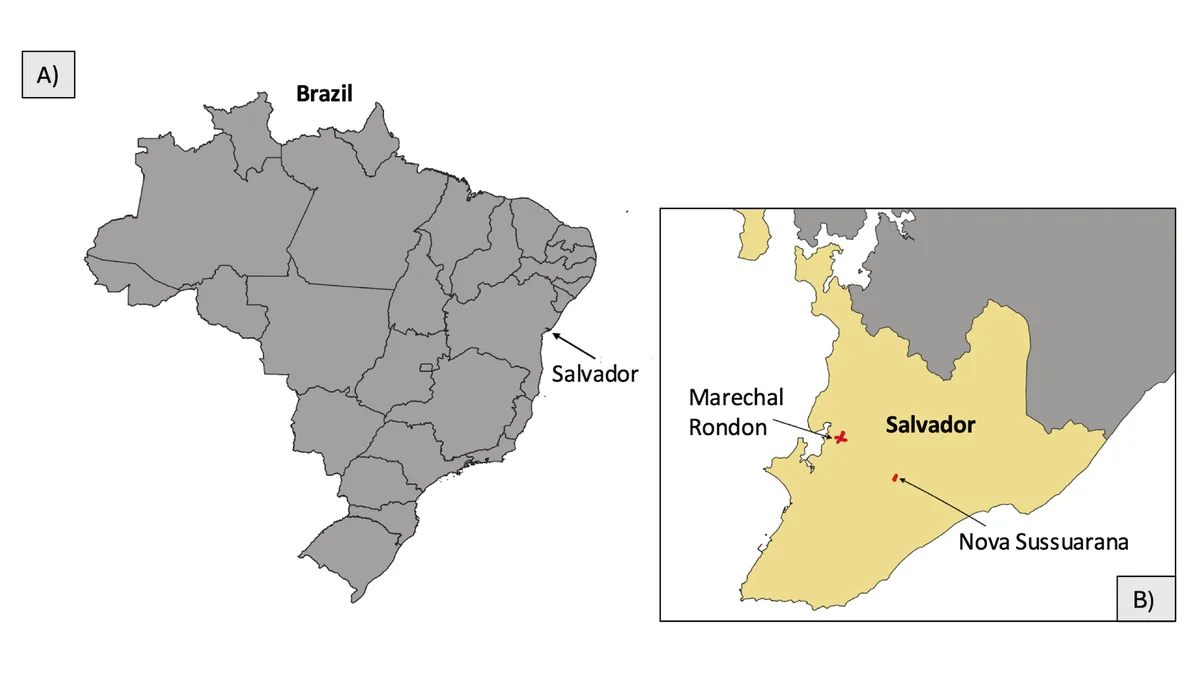
A paper of 1 October 2026 in PLOS Neglected Tropical Diseases surveyed two low-income communities in Salvador, Brazil (March–December 2023): ovitraps at 174 households and an environmental survey at 119. Ae. aegypti egg counts were strongly linked to trap location, garbage in front of the house, living within 10 m of an open sewer and open plastic containers around the home.
Main points
- Journal: PLoS Negl Trop Dis 20(10): e0014728. DOI 10.1371/journal.pntd.0014728. Received 15 December 2025; accepted 3 September 2026; published 1 October 2026. Authors: Griffin E et al.
- Methods: ovitraps for eggs and immatures; visual inspection of water-holding sites around homes; land-cover classification from satellite imagery; multivariate modelling.
- Results: 303 traps recovered; 85 indoor (55.6%) and 123 outdoor (82.0%) traps had eggs; 11,211 eggs in total. No clear spatial clustering. Breeding was most prolific in the peri-domestic area.
- The authors propose better waste disposal, water storage and sanitation to make vector control more effective, led by communities.
VPMA’s note
A study in Brazil. The ovitrap and yard-inspection approach is useful when members advise clients; the figures do not represent Vietnam.
- Source
- PLOS Neglected Tropical Diseases
- Published
- 1 October 2026
- Section
- Research · Insects
- Journal
- PLoS Negl Trop Dis 20(10): e0014728
- DOI
- 10.1371/journal.pntd.0014728
Editorial note: This is a short summary and comment by VPMA, not a full copy. The original text and copyright belong to the source cited. Picture: Figure 1 of the PLOS NTDs paper (map of the study area, CC BY licence).
Source: PLOS Neglected Tropical Diseases (summarised in English by VPMA). Read the Vietnamese page.