
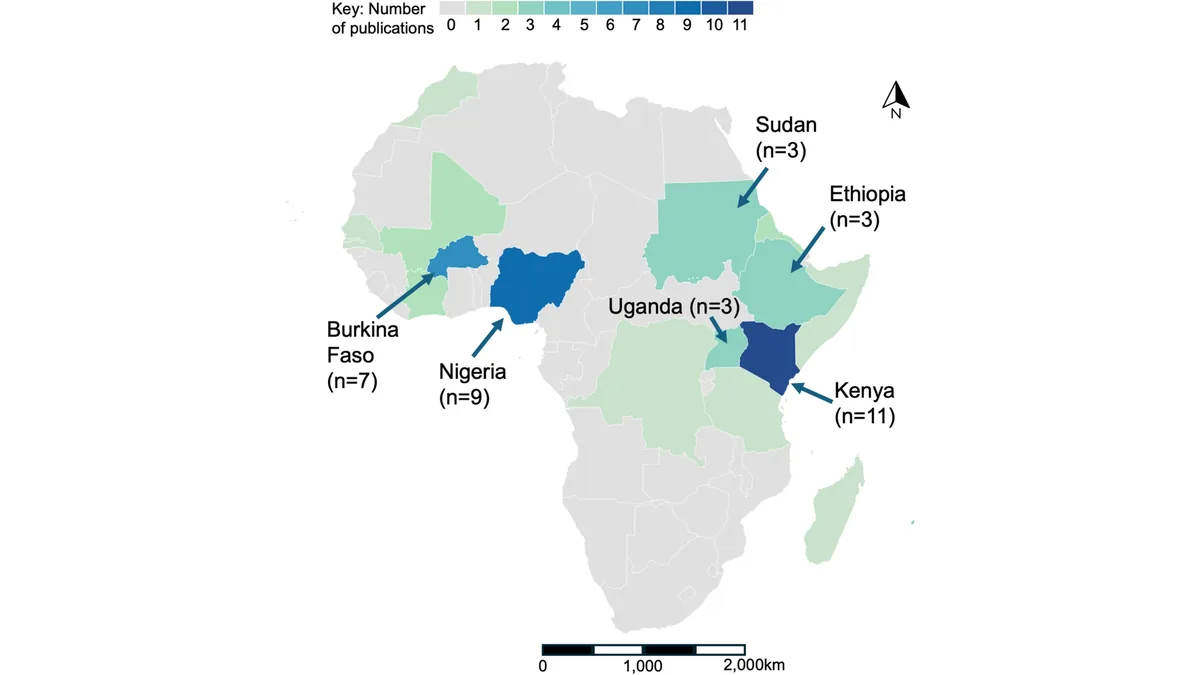
Published on 17 October 2025: a scoping review of 877 full-text papers on Aedes vector surveillance, control and insecticide resistance in Africa (1980–2023). Only Senegal and La Réunion had published sustained surveillance systems; RCT/epidemiological evidence on control effectiveness remains thin; many resistance tests used Anopheles doses and may underestimate Aedes resistance.
Main points
- Journal: Parasit Vectors. DOI 10.1186/s13071-025-07049-7. From 17,337 records, 877 full texts; of these, 7 on sustained surveillance, 56 on control and 57 on insecticide resistance.
- Sustained surveillance was clear only in Senegal (Kedougou, Ferlo) and La Réunion; 50 of 54 countries had no paper meeting the authors’ routine-surveillance definition.
- Control: mostly bioassays or before–after designs; few epidemiological endpoints. Outbreak responses often combined larviciding, ULV spraying and community source reduction. Resistance: mostly WHO tube tests on adults; Ae. aegypti and Ae. albopictus; permethrin/deltamethrin resistance common in West and Central Africa; temephos resistance reported only in Cabo Verde after decades of use.
- The authors recommend evidence-based emergency-response plans, WHO 2022 discriminating concentrations for Aedes, and wider larval testing.
VPMA’s note
This is an Africa-wide review. It does not replace surveillance or resistance data for Vietnam.
- Source
- Parasites & Vectors
- Published
- 17 October 2025
- Section
- Research · Insects
- DOI
- 10.1186/s13071-025-07049-7
- Scope
- 1980–2023
Editorial note: This is a short summary and comment by VPMA, not a full copy. The original text and copyright belong to the source cited. Picture: Figure 2 of the Parasites & Vectors paper (map of publication counts).
Source: Parasites & Vectors (summarised in English by VPMA). Read the Vietnamese page.