
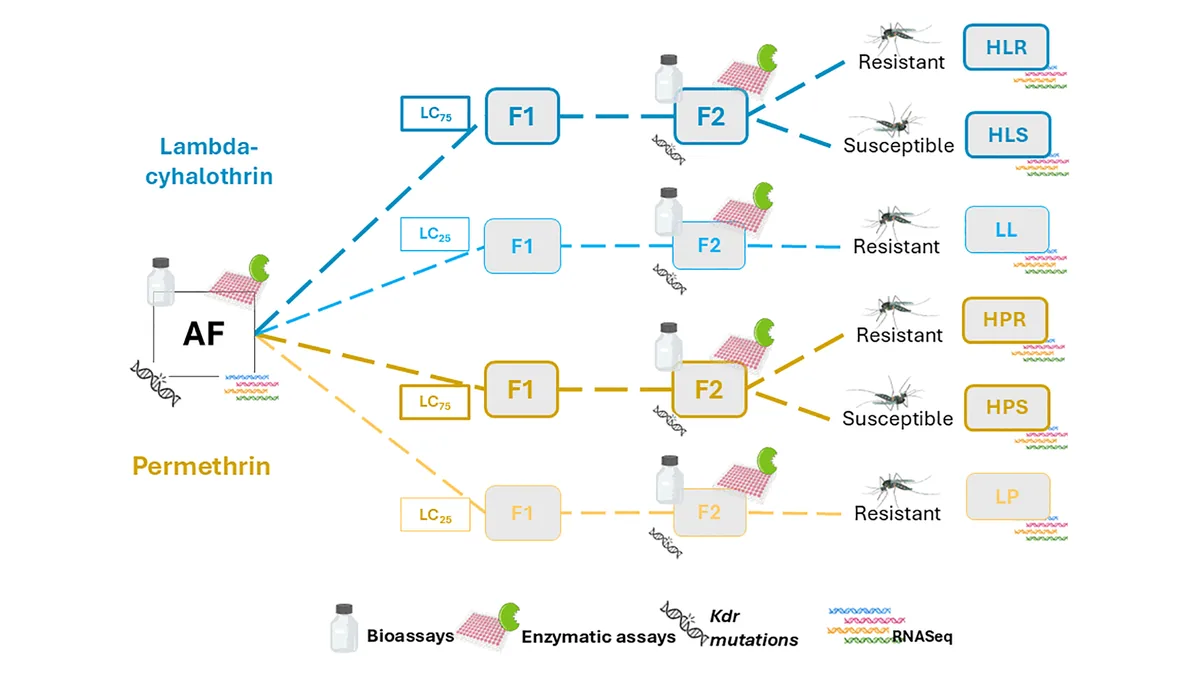
A paper of 24 September 2026 in PLOS Neglected Tropical Diseases: a University of Antioquia team selected a resistant Colombian Ae. aegypti strain with permethrin (type I pyrethroid) and lambda-cyhalothrin (type II) at low (LC25) and high (LC75) concentrations, then measured kdr mutations, enzyme activity and RNA sequencing.
Main points
- Journal: PLoS Negl Trop Dis 20(9): e0014144. DOI 10.1371/journal.pntd.0014144. Received 11 March 2026; accepted 11 September 2026; published 24 September 2026. Authors: Muñoz AM et al.
- kdr mutations (F1534C, V410L, V1016I) and detoxifying enzymes gave only moderate resistance; the original strain already had F1534C nearly fixed before selection. The strain selected with lambda-cyhalothrin at LC75 showed about a 3-fold rise in resistance ratio after only two generations.
- Lambda-cyhalothrin raised expression of electron-transport-chain, mitochondrial, oxidative-stress and tRNA genes. Permethrin strongly raised cuticle genes, CYP450 genes (especially CYP4) and odorant-binding proteins, more so at the higher concentration.
- The authors conclude that both the pyrethroid type and the concentration matter; low field doses (dilution, uneven coverage) can still select for tolerance.
VPMA’s note
A laboratory experiment on one Colombian strain. Members should mix the correct dose and spray evenly; do not use these results to describe mosquito populations in Vietnam.
- Source
- PLOS Neglected Tropical Diseases
- Published
- 24 September 2026
- Section
- Research · Insects, Chemicals
- Journal
- PLoS Negl Trop Dis 20(9): e0014144
- DOI
- 10.1371/journal.pntd.0014144
Editorial note: This is a short summary and comment by VPMA, not a full copy. The original text and copyright belong to the source cited. Picture: Figure 1 of the PLOS NTDs paper (diagram of the selection experiment, CC BY licence).
Source: PLOS Neglected Tropical Diseases (summarised in English by VPMA). Read the Vietnamese page.