
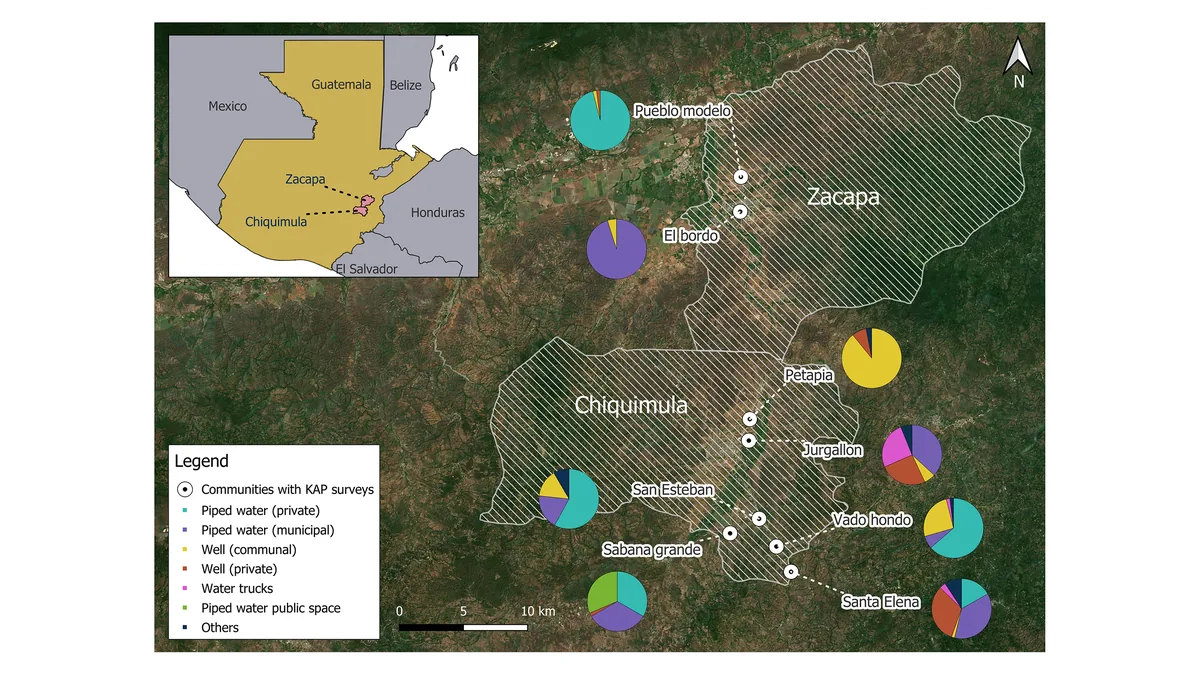
A paper of 3 September 2026 in PLOS Neglected Tropical Diseases surveyed knowledge, attitudes and practices (KAP) among 346 household representatives in eight communities of Zacapa and Chiquimula, Guatemala: about 90% knew mosquitoes spread dengue, yet 37% of households did nothing to remove breeding sites. Most were open to copepods (tiny crustaceans that eat mosquito larvae) if given information, technical support and assurance on water safety.
Main points
- Journal: PLoS Negl Trop Dis 20(9): e0014654. DOI 10.1371/journal.pntd.0014654. Received 20 August 2025; accepted 6 August 2026; published 3 September 2026. Authors: Louis VR, Montenegro-Quinoñez CA, Bärnighausen T, Dambach P (Heidelberg Institute of Global Health, Germany; University of San Carlos of Guatemala).
- Current practice: over three quarters of households store water, 61% in open containers; only 16% use covered containers only. 48% use just one breeding-site measure. Against adult mosquitoes, 28% spray insecticide, 22% use bed nets and 25% do nothing; 69% of households use no bed nets.
- On copepods: most had never heard of them but would consider them if given information, guidance or trained support. The main concerns were the safety of stored water and lack of knowledge about the method; urban communities were more concerned than rural ones.
- The authors cite copepod programmes in northern and central Vietnam, where community volunteers monitored and replenished copepods, as a success story, and stress that community acceptance is not evidence of effectiveness; field trials are needed.
VPMA’s note
A survey in Guatemala; it did not measure larval control. When advising clients, members should remember that knowing mosquitoes spread disease is not enough: give concrete guidance on covering, changing and checking water containers.
- Source
- PLOS Neglected Tropical Diseases
- Published
- 3 September 2026
- Section
- Research · Insects
- Journal
- PLoS Negl Trop Dis 20(9): e0014654
- DOI
- 10.1371/journal.pntd.0014654
Source: PLOS Neglected Tropical Diseases (summarised in English by VPMA). Read the Vietnamese page.